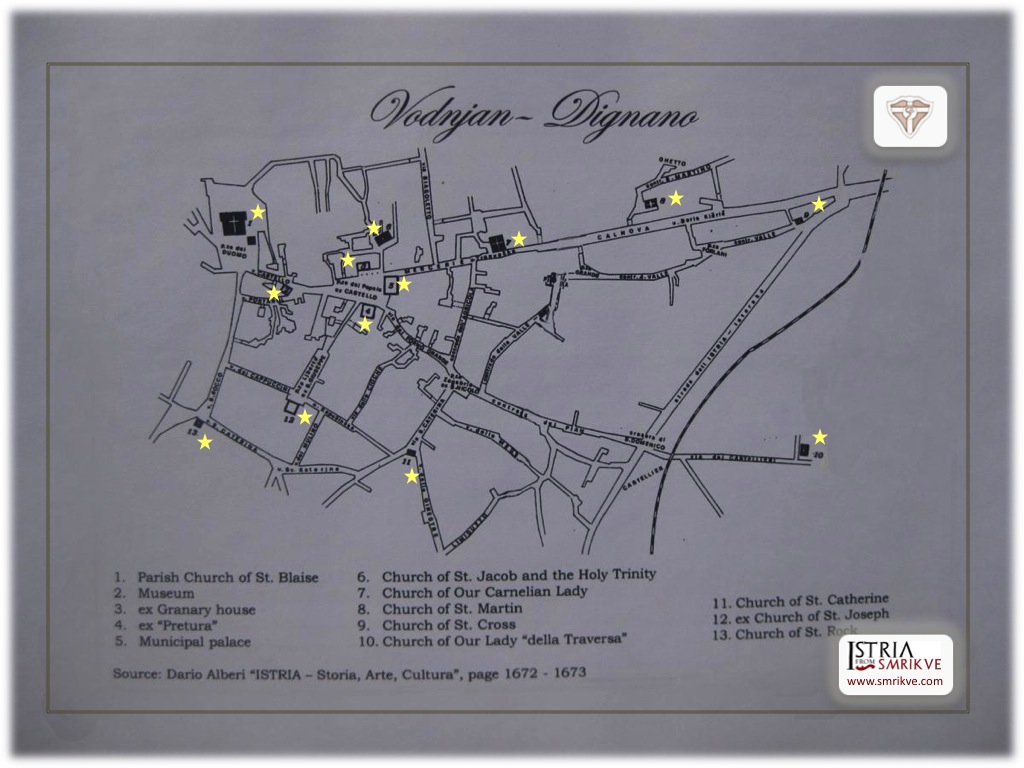
to enlarge

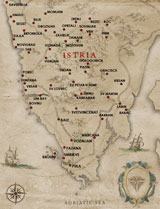
or choose the place
from the menu below
 Rome |
 Byzantium |
 Venice |
 Vienna |
 Brioni |
 Smrikve |
 |
 |
It is interesting to observe this small circular ground-plan houses with roof of stone slates that remained the dry stone techniques of prehistoric times, but actually this ground-plan houses named in Istria “kazun” can be found in Greece, in Provence in France, in Puglia in Italy are named trulli and can be found also in some other places in Europe like: Cataluna and Galicia in Spain, Abruzzo and Sardegna in Italy, and also in Irland and in Scotland.
This made me think that only a civilisation, like the Roman civilisation was, could have been able to built such houses, in such a manner and so many of them. There are so perfect that today a part from Branko Orbanic and few other people almost nobody can do it. Branko Orbanic together with the town of Vodnjan is working to protect this historical heritage left to us by past civilisations.
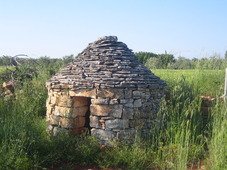 Dado Belci recently told me a nice story that when he was a child, in 1984, his father
and uncle built the first new “kazun” after the second World War. He remember that they used a huge amount of
stones and the TV pictured the process. To see this “kazun” you have to take the new raod that connect Vodnjan
to the highway “Y”. Passing the bridge, in that the middle of the olive trees, you may be lucky to see it.
Dado Belci recently told me a nice story that when he was a child, in 1984, his father
and uncle built the first new “kazun” after the second World War. He remember that they used a huge amount of
stones and the TV pictured the process. To see this “kazun” you have to take the new raod that connect Vodnjan
to the highway “Y”. Passing the bridge, in that the middle of the olive trees, you may be lucky to see it.
As I said only around Vodnjan there are over 2000 of this ground plan houses with roof of stones slates. There are not spread all over Istria but only in parts that were mostly cultivated during the Roman Empire period.
Istrian olive oil was one of the best in the Empire and there were several millions of olive trees in Istria. At the time this houses were needed by the workers for various reasons and this made me think that this is another rests that Roman civilisation left as heritage to Istria.
Vodnjan has still today one of the most important olive oil processing plants in the southern Istria. Smrikve olive oil is processed in Vodnjan. This village has probably the longest tradition of olive oil making in Istria.
There is also an increasing number of top-quality winemakers around Vodnjan. Giacometti – Moscarda produce a very good wine that you should taste. The most important families that produce outstanding Istrian olive oil are: Lorenzo and Livio Belci, Sandi Chivalon, Giacometti Moscarda and Gianfranco Macan.
Sandi Chiavalon is a very young olive oil producer and recently in a World Competition that was hold in Italy he entered among the top 15 most prominent producers of the olive oil in the World.
The outstanding results among the top olive oils producers have been obtained also in the Italian city of Parma at the World competition where Belci family, Sandi Chiavalon and Antonio Pastrovicchio obtained second prizes in the absolute competitions.
A part of the above mentioned families that work on the promotion of Istrian olive oil and wine there is also Agroprodukt company that is among the key players in the area.
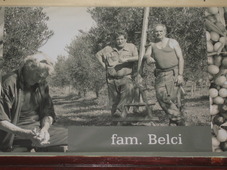 Family Belci recently created the tasting facility for the olive oil and continuously
invest in research and knowledge.
Family Belci recently created the tasting facility for the olive oil and continuously
invest in research and knowledge.
There is a long research needed to find the more suitable olive oil for various dishes. The art of olive oil coupling with food is similar to the art of wine coupling. It is a long time project but for sure it will give results to the future generations.
Istrian olive oil was historically the best in the Roman Empire and with this tradition the current olive oil should aim to hold top positions in the World ranking with its quality. All the above mentioned families are producing outstanding olive oil.
Vodnjan is also the headquarter of Svijet Biljaka Company. This company promotes and develops the Istrian Lavender project. The project envisage to plant in few years several hundred of hectares of Lavender in the Istria region and many hectares have already been planted.
Svijet Biljaka produces also many other natural products based on the plants that grow in Istria. Thare are several type of Smrikva products based on Juniper.
The area of Vodnjan and Galizana were historically famous for the plants used in the production of traditional medicine products.