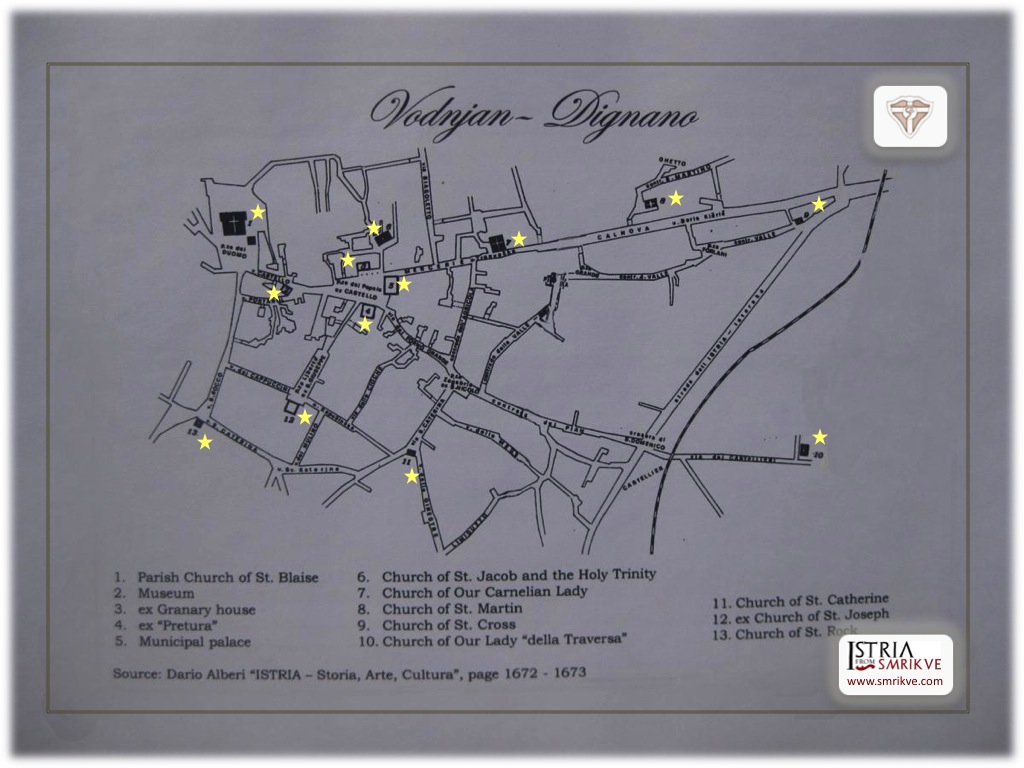
to enlarge

or choose the place
from the menu below
 Rome |
 Byzantium |
 Venice |
 Vienna |
 Brioni |
 Smrikve |
 |
 |
It is worth to remember that Istria had some important fullonica during the Roman Empire period. Fullonica was a cleaning facilities, that in their cleaning processes used also lavender.
Pula had an important fullonica in the 3rd century and also one of the most luxurious Villas of the Roman Empire, the one that was spread on 5 hectares in Verige Bay on the Brioni islands had its own fullonica.
Lavender has a very sweet smelling to most of the people and is known that during the Roman period Arena in Pula had the wells with the sweet smelling water placed on the top of the square towers that were activating the fountains inside the amphitheatre. This way the Romans were actually spreading the nice smell in the Arena.
The Istrian Lavender is already processed and transformed into various products. If you are in Smrikve in August you may consider to visit the traditional and popular “Bumbari” party or also the Istrian Lavender Festival that was organized for the first time in 2008. People from Vodnjan are named Bumbari that in English means hornet and in Italian would mean “calabrone”.
I used to hear from the older people that many centuries ago inhabitants from the Italian region Calabria moved to Vodnjan and that this was the reason why they were named Bumbari. I am not sure this story is right but thanks to the oral tradition it has arrived till the current times.
In the second weekend in September there is ex tempore, an art competition on a given theme. There are also several olive oil, lavender and wine makers meetings and discussions forums organized in Vodnjan during the whole year. One of Vodnjan’s development strategies is to restore the traditional value this area had in the past for the agriculture.
If you want to taste some good food in Vodnjan, as I said before, one of the best restaurants with traditional food is for sure Vodnjanka. Only 5 kilometres outside Vodnjan you can also try Stancija Negricani agrotourism. Stancija Negricani is a very lovely place restructured with passion. In the last years there are more and more old houses turned into their antique beauty all over Istria and Stancija Negricani is one of them.
In Vodnjan’s photo gallery you will find several pictures of the building of this lovely medieval Istrian town that have been described in the text above.
VODNJAN – HISTORICAL OVERVIEW
Vodnjan is another old Istrian town and it is not proved that it was a prehistoric hill fort settlement but is known that was a Roman settlement named Attinianum or Altinianum.
Pula was the most important Roman settlement in Istria and Vodnjan was not so important at the time as town but was very important as agricultural location. The area that goes from Pula to Vodnjan is very interesting to better understand Roman urbanization system.
It is known that decumano street had the orientation east-west while the cardo street had the orientation north-south. “Limites” were the parallel streets with decumano street and “calles” were parallel to cardo street.
“Pagi” or “vici” were the spots were “limites” and “calles” were crossing. “Centuria” was the measure unit for the areas. Not much of that urbanization have been preserved but from some documents and maps you can see how advanced and intelligent that system was. The basic measures for the land where 71 and 710 meters.
During the Roman period Vodnjan was mostly the area dedicated to the olive oil production. The village lived a nice period during the Byzantine period and in 751 suffered a Longobard attack. After 788 was part of Charlemagne Kingdom.
The first written document where Vodnjan is mentioned dates back into 1194. In that period Vodnjan was named Antinianus and until 14th century was named Adignano.
In 1209 Bishops of Pula donated Vodnjan to the Aquileia Patriarchs. In the mid of the 13th century Vodnjan became a property of Castropola family from Pula.
In 1330 Vodnjan participated in the war between Castropola family and the County of Pazin when several towns and villages under Castropola leadership attacked Barban. With participation into this conflict Vodnjan aimed to exit from the Aquileia Patriarchs dominions but Castropola were defeated.
The economy of Vodnjan in the 13th and 14th century was based mainly on wood exploitation, cattle breeding, olive oil and wine production.
At the time also excavation of “saldame” sand was developed that was later on used for the famous glass artworks made by the artists in Murano.
Until 1330 Vodnjan was under Pula’s administration. When Pula decided to pass under Venice, Vodnjan decided to become an independent municipality and in 1331 joined Venice.