to enlarge

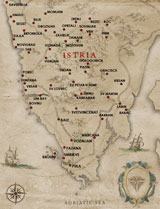
or choose the place
from the menu below
 Rome |
 Byzantium |
 Venice |
 Vienna |
 Brioni |
 Smrikve |
 |
 |
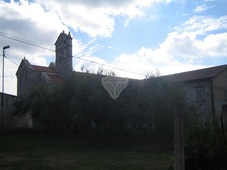 After visiting Maria Formosa turn back
towards “Sergi Street” and take the stone paved street that leads you towards Pula’s hilltop and to the
Franciscan Church.
After visiting Maria Formosa turn back
towards “Sergi Street” and take the stone paved street that leads you towards Pula’s hilltop and to the
Franciscan Church.
You will see many stone paved streets in the Old Town of Pula that can bring you to the hilltop of the town, but the street that will bring you to the Franciscan Monastery is located about hundred meters before Foro Square.
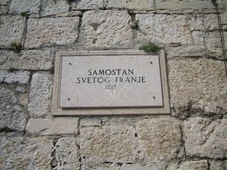 The complex dates back to the 13th century
and represents a masterpiece of Monastic Gothic architecture. The church was completed in 1314, but there are other valid
assumptions about its origin and foundation. Some architectural elements could date back to the beginning of the 13th century.
Some historians assert that the Monastery was founded in 1229 by St. Francis in person.
The complex dates back to the 13th century
and represents a masterpiece of Monastic Gothic architecture. The church was completed in 1314, but there are other valid
assumptions about its origin and foundation. Some architectural elements could date back to the beginning of the 13th century.
Some historians assert that the Monastery was founded in 1229 by St. Francis in person.
It is known that St. Francis visited Istria in 1229. Other sources assume that this opera was supported by the Sergi or Castropola family in 1285.
This Church hosts many concerts during the year and you might be lucky enough to hear one of them if you visit the site in the evening. This is also the preferred site for accordion music concerts during the International Summer School.
 You should also know that Pula has a very important longstanding accordion tradition
mainly thanks to Stanko Mihovilic, a musician from Lovran that educated many generations of musicians and
thanks to whom Pula is today the seat of the Accordion Music Academy.
You should also know that Pula has a very important longstanding accordion tradition
mainly thanks to Stanko Mihovilic, a musician from Lovran that educated many generations of musicians and
thanks to whom Pula is today the seat of the Accordion Music Academy.
The accordion orchestra still bears his name and probably, for the passion and years he dedicated to the accordion and to Pula’s youth, Stanko Mihovilic also deserves to have a Pula Street named after him. Stanko Mihovilic also promoted “Susreti”, an International competition that continues to gather the most talented accordion players from several European countries.
I remember I was lucky to win first prize twice in this competition when I was studying music. This is a nice memory. My first International experiences happened thanks to music and the accordion orchestra “Stanko Mihovilic” that allowed me to visit many nice places around Europe.
Every year in July The International Summer School brings together a great number of players from all parts of the World. The School’s professors are world-famous musicians.
If you are in Pula during the days of the Summer International Accordion School you may get lucky and hear the concerts of Peter Soave or Skljarov, or some of the other World renowned accordion players.
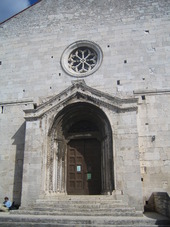
Let’s go back to the architectural beauty of the complex. There are two important elements on the façade of this Franciscan church: the rose and the portal. They are both beautiful.
The architecture of the whole complex is very simple. In a way it reflects the Order and the ideas of simplicity St. Francis had, but some details on the church are artwork decorations.
 On the main altar in the church you can see a high quality wooden polyptych with two
rows of polychrome depictions of Saints in relief with a richly carved frame. It is thought that this work of art was made
by Jacopo from Pula at the beginning of the 14th century, others believe that it could have been made by Cristoforo
from Ferrara in the first half of the 15th century or by Vivarini masters in the second half of the 15th century. All these
masters were inspired by Venetian artistic influence.
On the main altar in the church you can see a high quality wooden polyptych with two
rows of polychrome depictions of Saints in relief with a richly carved frame. It is thought that this work of art was made
by Jacopo from Pula at the beginning of the 14th century, others believe that it could have been made by Cristoforo
from Ferrara in the first half of the 15th century or by Vivarini masters in the second half of the 15th century. All these
masters were inspired by Venetian artistic influence.
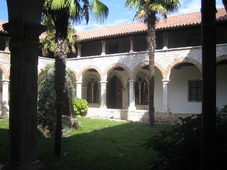
Another rare beauty and a must see is the cloister found in the Monastery.