to enlarge

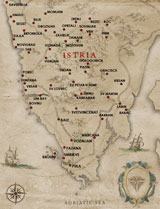
or choose the place
from the menu below
 Rome |
 Byzantium |
 Venice |
 Vienna |
 Brioni |
 Smrikve |
 |
 |
Before you continue the tour you can take the first road that turns right towards the hill and after fifty meters on the right side you will see the façade of the Church of the Holy Heart.
On “Sergi Street” you ought to look towards the façades of the houses because there are several very interesting coats of arms and sculptures that are worth a snapshot.
 Once you reach another small square at the end of “Sergi Street” on your
left side you will see a garden with some Roman sarcophagus. If you continue to walk forward you will reach Foro square. If
you turn right towards the hilltop you will go towards the Franciscan Church and Monastery. If you turn left you will go towards
the famous Roman house floor mosaic “The Punishment of Dirce” and towards the Chapel of St. Maria Formosa. Each
of these places is worth a visit but let’s start with the floor mosaic.
Once you reach another small square at the end of “Sergi Street” on your
left side you will see a garden with some Roman sarcophagus. If you continue to walk forward you will reach Foro square. If
you turn right towards the hilltop you will go towards the Franciscan Church and Monastery. If you turn left you will go towards
the famous Roman house floor mosaic “The Punishment of Dirce” and towards the Chapel of St. Maria Formosa. Each
of these places is worth a visit but let’s start with the floor mosaic.
It is not easy to find this floor mosaic in the Roman house because there is a modern building built above it. The best way would be for someone to show you where it is.
Once you reach the end of Sergi Street, coming from the Golden Gate, you should turn left. When you get to the end of the building turn left again and at the end of this large house you will see small doors on your left side. On the right side there is the Chapel of St. Maria Formosa.
This floor mosaic dates back to the 3rd century and is connected to the Legend of Dirce from Greek Mythology. This artwork is 12 meters long and 6 meters wide.
The beauty of this mosaic gives you an idea of the beauty of the houses. Romans liked mosaics.
The second idea you get by looking at this floor mosaic is the level of the town during the Roman period. Later on the Austrians rebuilt the town above the Roman ruins and the current town level is from the Austro-Hungarian period.
Today the level of the town is about one to two meters above the Roman town level. I read that the sea level in this area increases by one meter every thousand years so likely the level of the sea when Romans built Pula was two meters below the level we have today.
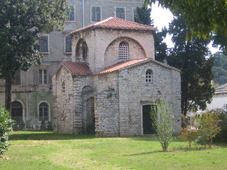 Very close to the floor mosaic of the Roman house you will also see a part of what was
once a three-nave Basilica from the 6th century, St. Maria Formosa. The Chapel was built under the rule of
Justinian, Emperor of the East Roman Empire, in 547.
Very close to the floor mosaic of the Roman house you will also see a part of what was
once a three-nave Basilica from the 6th century, St. Maria Formosa. The Chapel was built under the rule of
Justinian, Emperor of the East Roman Empire, in 547.
It was built by St. Massimiano who was native to Vestar, located nearby Rovinj. St. Massimiano was also the Archbishop of Ravenna and the founder of the Benedictine Order of St. Maria. Almost all the Istrian Monasteries, up to the 13th century, belonged to this Order.
The name Formosa (which means magnificent) was given to this Basilica due to its beautiful marble decorations, mosaics and stucco works. Some beautiful marble columns of this Basilica ended up in the most important Churches in Venice.
The complex was demolished in the 16th century and only the southern chapel has been preserved. It is likely that this Basilica was built on a place where Minevra’s Temple was located.
According to some sources this Basilica was probably comparable in its beauty to the Euphrasian Basilica in Porec.
It is also likely that in 1242 the Venetian Doge Giacomo Tiepolo took four columns from the Basilica to place them behind the main altar of the St. Mark’s Basilica in Venice.
Other columns were incorporated into the Duke’s Palace in Venice and into the Church of Our Lady of Health.
In the 16th century, Jacopo Sansovino came to Pula to restore the Basilica, but at the time it was already in such poor condition that only the Chapel was preserved and can still be seen today.