to enlarge

or choose the place
from the menu below
 Rome |
 Byzantium |
 Venice |
 Vienna |
 Brioni |
 Smrikve |
 |
 |
This cloister is probably the most beautiful one in Istria. It was erected at the same time as the Church but was reconstructed in the 15th century. The cloister columns feature early Renaissance art.
I like the garden in the middle of the cloister but also some Gothic architectural elements on the east façades.
The arches are really superb works of art and today are used as the entrance to St. John’s Chapel. Inside it you can see part of the floor mosaic that dates back to the 4th century. The Sergi Family tombs were located in the nearby chapel.
During the Napoleonic period the Monastery was used for military purposes. Later on it was used the by Austro-Hungarian Monarchy as a storage area and during the Italian period the Monastery was restored and returned to the Order of St. Francis in 1927.
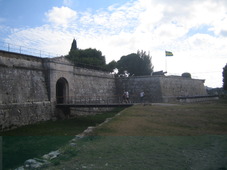 From the Franciscan Monastery I recommend that you continue the visit towards the hilltop.
There you will find another impressive building: the Venetian fortress, also named Kastel. This fortress
was built in 1630 by the French architect Antoin de Ville.
From the Franciscan Monastery I recommend that you continue the visit towards the hilltop.
There you will find another impressive building: the Venetian fortress, also named Kastel. This fortress
was built in 1630 by the French architect Antoin de Ville.
In prehistoric times, on the same spot, there was a prehistoric hill fort settlement of the Histri tribe. Later on there was the Roman Campidoglio and during the Middle Ages Castropola’s castle was built here by the Aquileia Patriarchs. The fortress was restored during the Napoleonic period and once again in 1830 by the Austrian Empire.
Today Kastel hosts the Historical Museum of Istria. The museum also hosts some ship designs made in the Uljanik shipyard and it is fascinating to see how good these designers were at the time. They did not have cad-cam computer drawing systems but the drawings are excellent. You can visit the fortress and enjoy the panorama all around Pula. During the summer it is often the venue of theatre performances or film nights.
In front of the fortress there is a map with short descriptions of Austro-Hungarian fortresses around Pula. At the end of the 19th century, Pula was probably one of the best protected places in the World.
After you have completed the visit of the fortress you can turn back towards the Franciscan Monastery and Sergi street and go visit the most important square in the Old Town of Pula, named Foro Square. In Rome they are named “Fori Romani”. This was the main town square during the Roman period.
The Foro Square, the Roman forum, was the antique town’s central square and represents a rectangular space of 37 x 81 meters in size. Located all around the square were the most important buildings of the religious, administrative and judicial life of the town. The square was also used for economic activities and there were markets and numerous shops all around.
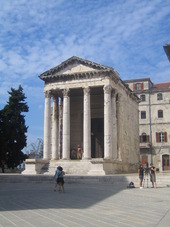 The first building that will impress you with its six Corinthian style columns is the
Temple of Augustus. The Temple is around 18 meters long, 8 meters wide and 12 meters high.
The first building that will impress you with its six Corinthian style columns is the
Temple of Augustus. The Temple is around 18 meters long, 8 meters wide and 12 meters high.
This Roman artwork has incorporated the elements of Vitruvio’s golden period into its architecture and it was not just a case that this Temple also impressed the famous Renaissance Architect Andrea Palladio, who studied this building.
You will find elements from the Temple of Augustus in many of Palladio’s buildings.
The Renaissance period rediscovered the arts and knowledge of antique civilisations where harmony and symmetry were closer to nature than they are today.
Thomas Jefferson, the third US President, projected his house in Monticello being inspired by Palladio. Many Palladio's buildings and also Thomas Jefferson house are today on UNESCO list and in part we can thanks Pula's Augustus Temple.