to enlarge

or choose the place
from the menu below
 Rome |
 Byzantium |
 Venice |
 Vienna |
 Brioni |
 Smrikve |
 |
 |
During the 18th century Scipione Maffei proposed to transfer the Temple of Augustus to Venice and to use it as a School of Architecture.
This was the third monument, after the Arena and the Triumphal Arch of Sergi, that could have been moved from Pula to Venice between the 16th and 18th century.
You have to imagine the town with 100 inhabitants. In 1650 Pula had only 100 inhabitants. It was basically a dead town with only many important Roman monuments. There were no people in town and there was no one to keep up the maintenance of the monuments.
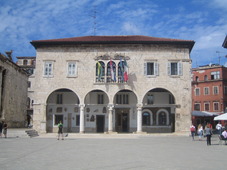 Close to the Temple of Augustus you will also see the Town Hall, the
building that hosts Pula’s main Municipal office.
Close to the Temple of Augustus you will also see the Town Hall, the
building that hosts Pula’s main Municipal office.
This building was built at the end of the 13th century but was restructured many times: after 1380, in 1560, in 1602. In 1634 the Palace was in such a bad condition that the Podesta decided to leave it.
In 1651 a part of the roof and the main façade collapsed. It was rebuilt as we see it today by Giacomo Barbaro between 1696 and 1698.
The main façade is still an interesting example of Venetian style buildings. It has a ground floor portico with Renaissance columns and a “trifora” on the floor above the portico.
I have seen the pictures of this building that were made at the end of the 19th century and at the time the building was even more beautiful than today because the main façade, above the “trifora”, had a nice tower façade with a bell and a clock.
 What is interesting about this building is that, apart from the main façade,
all the other façades are made with pieces of many other buildings and stone blocks. It is a sort of architectural
engineering patchwork.
What is interesting about this building is that, apart from the main façade,
all the other façades are made with pieces of many other buildings and stone blocks. It is a sort of architectural
engineering patchwork.
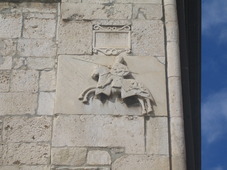
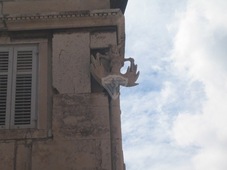
Three interesting stone sculptures are placed on the façade: Bartolomeo de Vitrei, Gnome Telamone and Siren Caryatid.
Bartolomeo de Vitrei was the Podesta’ of Pula when the building was built for the first time in 1296.
At the back of the building you will see the remains of another Temple that was identical to the Temple of Augustus and was likely dedicated to Diana. The third and central Temple of the square is assumed that was dedicated to Pula's Patron of the town during the Roman Empire - Hercules.
Studies prove that once upon a time, in Foro square, there were three temples and you can see the pictures on the board located in the square.
The Temple of Augustus was built between 2 BC and 14 AD and is dedicated to Augustus, the first Roman Emperor. It ranks among the most beautiful Roman monuments in Pula. Its columns have richly decorated Corinthian capitals.
 When Christianity was recognized as the
official religion of the Empire by the Edict of Milan this temple was turned into a Church. There was also a period when the
Temple was used as granary.
When Christianity was recognized as the
official religion of the Empire by the Edict of Milan this temple was turned into a Church. There was also a period when the
Temple was used as granary.
At the beginning of the 19th century the Napoleonic Marshal Marmont launched an initiative to create a collection of Antique stone monuments inside the Temple, and so today the Temple hosts a collection of Roman sculptures that were found around Pula.