to enlarge

or choose the place
from the menu below
 Rome |
 Byzantium |
 Venice |
 Vienna |
 Brioni |
 Smrikve |
 |
 |
It is assumed that the oldest temple was the one that stood in the middle. This temple was probably dedicated to the capitol triad: Jupiter, Juno and Minevra. The Temple of Augustus that we can see today was built later on by the Emperor Augustus and was dedicated to Augustus and to Rome. The third one, the temple dedicated to Diana, was probably built by the Emperor Vespasianus.
During the Second World War the Temple of Augustus was hit by an airplane bomb and was almost totally destroyed. It was restored between 1945 and 1947.
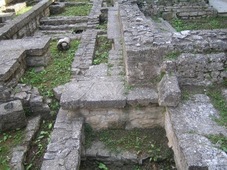 The stone pavement of the Roman forum lies
about 120 centimetres under the present surface and a few years ago during maintenance works on the square it was possible
to see the original Roman stones of the square.
The stone pavement of the Roman forum lies
about 120 centimetres under the present surface and a few years ago during maintenance works on the square it was possible
to see the original Roman stones of the square.
There are several interesting buildings in this square that you can enjoy if you like the architecture.
There is another interesting Roman location named Agrippina’s house located between Forum Square and the street that turns towards the Franciscan Monastery.
If you visit Pula’s Forum Square during the summer, in the evening hours, you might happen across traditional cultural programs “on the streets and squares”, which includes performances of members of the Association of Cultural and Artistic Societies.
You may hear Pula’s Wind Orchestra, or see the folk ensemble KUD “Uljanik” that perform some Istrian folk songs and dances. There are also performances by Studio “Zaro”, “Stanko Mihovilic” Accordion Orchestra, choruses “Matko Brajsa Rasan” and “Lino Mariani” and theatre performances by “Dr. Inat” group, etc.
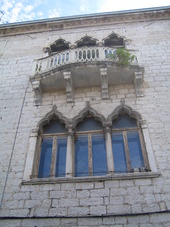 You can continue to walk and follow the street that passes nearby the Town Hall and
on this street, today named Kandlerova street, you will see several nice Palaces.
You can continue to walk and follow the street that passes nearby the Town Hall and
on this street, today named Kandlerova street, you will see several nice Palaces.
The first one is located on the right side of the street and is named Demartini Palace. This Palace was built in the 16th century and has a beautiful “trifora” on the first and second floors.
The next important building is located on the left side of the street in the first square you find on this street. This building, 50 meters long and 25 meters wide, is Pula’s Cathedral and is located near the seaside. You will recognize the building from the big bell tower.
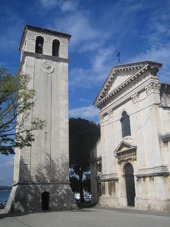 The Cathedral was erected on the foundations of a 4th century Roman temple. At
the beginning it was a single-nave church dedicated to St. Mary. Just beside it there was also a church dedicated to St.
Thomas, the patron of Pula. Even today the Cathedral is known by people as St. Thomas Cathedral.
The Cathedral was erected on the foundations of a 4th century Roman temple. At
the beginning it was a single-nave church dedicated to St. Mary. Just beside it there was also a church dedicated to St.
Thomas, the patron of Pula. Even today the Cathedral is known by people as St. Thomas Cathedral.
In the 5th century the original Church was divided into a three-nave Basilica. The new façade was completed in 1712 in the early Venetian Classic style while the bell tower was completed in 1707. The bell inside the tower was made by Salvador from Pula during the 15th century.
In 1380 Pietro Doria from Genova took the bronze doorway from this Cathedral. It was a Byzantine work of art made in the 9th century. Today this piece of art can be seen in Genoa on the Temple of St. John in the Church of St. George.
In 1417 the Bishop Biagio Molin rebuilt the Cathedral by using a lot of important and valuable historical stone blocks. During its last renovation, when the bell tower was built, Bishop Giuseppe Maria Bottari also used historical stone blocks for the building foundations.