to enlarge

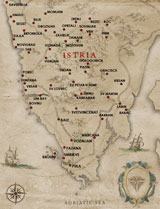
or choose the place
from the menu below
 Rome |
 Byzantium |
 Venice |
 Vienna |
 Brioni |
 Smrikve |
 |
 |
On the right side of the Cathedral, the southern part, you will note a very nice portico. Inside the portico there is a beautiful stone Cathedral doorway from 1456.
This doorway is decorated with Renaissance reliefs and was taken from the demolished Benedictine abbey of St. Michael. Dante Alighieri stayed in the Benedictine abbey of St. Michael during his visit to Pula.
At the end of the street, on the left side, you will notice a large building. This is Pula’s public library. The park that you see on the other side of the street is the park near Karolina where we started the tour.
 You can take your car from the Karolina parking lot and take the road that runs near
the sea towards Veli Vrh. On the right side of the road you will see several attractive buildings built during the Austro-Hungarian
period.
You can take your car from the Karolina parking lot and take the road that runs near
the sea towards Veli Vrh. On the right side of the road you will see several attractive buildings built during the Austro-Hungarian
period.
The first one is Hotel Riviera, the beautiful yellow building built in 1909 in Art Nouveau style. I used to live in that building before we completed our new home in Smrikve.
 The second building is Pula’s railway
station. It is another charming building made with style in the 19th century.
The second building is Pula’s railway
station. It is another charming building made with style in the 19th century.
From the mid 19th century the Austrian Empire and later the Austro-Hungarian Monarchy encouraged Pula’s development. This was mainly due to the decision to turn Pula into a major naval port of the Empire. Pula only had a few hundred inhabitants when the Austrians arrived and in a few decades grew to host the number of inhabitants it has today.
Unlimited financial resources came to Pula from Wien in that period. During Austro-Hungarian rule, to fulfil the new role assigned to Pula, an almost new town was built with strong influences from Middle European tastes and culture.
This included buildings like: large public buildings (Admiralty building built in 1861 in neo-Classic style on the waterfront), theatre, schools (today’s Pedagogical faculty built in 1907 in Wien Secession style), hotels (Riviera), museums (the Archaeological Museum of Istra was founded in 1902 and located in 1930 in the onetime Royal Secondary School building from 1890), residential quarters with Secession style villas (on Veruda), etc.
The shipyard was opened, the military fortress defence system around Pula was created. Naval officers and Pula’s businessmen got their villas on Veruda, sort of like Barcelona’s Pedralbes or Los Angeles’ Beverly Hills. This was the part of the town where the most influential and wealthy people lived. Even today you can enjoy the beauty of those villas although most of them would need significant investment.
In 1876 Pula got a railroad. At the beginning of the 20th century Pula also got the electric street car, electric lights, and it became a meeting place for businessmen of the Empire. A theatre, beautiful gardens made Pula a very nice town. In addition, Pual Kupelwieser artwork over nature on the Brioni islands attracted a lot of famous personalities to Pula.
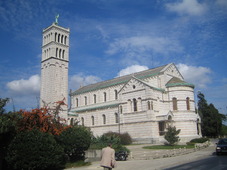 The last building I recommend that you visit is the Naval Church. This
church is located on Stoja, a few hundred meters before Milan’s restaurant and about five hundred meters before Gina’s
restaurant.
The last building I recommend that you visit is the Naval Church. This
church is located on Stoja, a few hundred meters before Milan’s restaurant and about five hundred meters before Gina’s
restaurant.
The Naval Church was built in 1891 and was consecrated in 1898 for the 50th anniversary of the Emperor Franz Joseph’s rule.
It is made from bicoloured marble like some churches you see in Florence. Its architecture is a mixture of neo-Romanesque and neo-Byzantine styles. Natale Tommasi was the architect of this beautiful structre. Natale Tommasi also projected the Parish Church of St. Agnes in Medulin and the building where the museum is located.