to enlarge

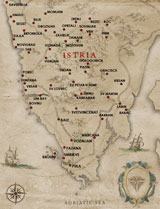
or choose the place
from the menu below
 Rome |
 Byzantium |
 Venice |
 Vienna |
 Brioni |
 Smrikve |
 |
 |
I hope you enjoyed this virtual tour. You can follow the path I described in the text by watching the photo gallery. Please also take note of a few recommended restaurants in Pula: Gina, Milan, Valsabbion and Vela Nera.
Gina is located in Stoja. It is a very lovely and romantic place with an Istrian fireplace and both very good food and wine. This is the place I prefer in the town because reminds me of some charming Italian restaurants. Milan is also located in Stoja and is one of the best restaurants in Pula with very good food and wine, and also very good cakes. Valsabbion is located in Pjescana Uvala and is another of the best restaurants in Pula. Vela Nera is also located in Pjescana Uvala.
In Pula’s photo gallery you will find few pictures of this largest Istrian town full of important Roman monuments.
PULA – HISTORICAL OVERVIEW
Pula is a very old Istrian town and the area of Pula was inhabited since the early Palaeolithic age, as proven by the findings from the nearby Sandalj cave. Several hundred thousand years ago the old inhabitants or “presapiens” walked around Pula.
As most other Mediterranean places the story of Pula’s foundation is also enveloped in legends. The most famous one is the myth of the Argonauts. According to this myth at the end of the 2nd millennium BC Pula was founded by Greek refugees from Kolhida who were running after Giasone and Medea.
Findings in Istrian prehistoric hill fort settlements prove that the Illyrian tribes traded intensively with the Greeks and this myth might be rooted in those contacts with Greek civilization.
Pula’s prehistoric hill fort settlement was located on the hilltop where the Kastel Fortress is found today. There are also several assumptions about the original meaning of the name Pula.
It is assumed that “Pol” in Celtic might mean some kind of hydrographical concept, probably a water spring. The epic poets from Alexandria: Licofrone and Callimaco, named Pula as Polai. According to the tradition Polai means “the town of the exiled people”.
In preshistoric times, Nesactium was the most important Illyrian settlement and Pula was less important.
The Roman conquest of the Istrian peninsula was very important for Pula’s rapid urban development. In the second half of the 1st century BC Pula became a military stronghold and later on an important trading centre and harbour for the exchange of various goods. In 43 BC Pula received the status of colony and the first written accounts about Pula also date back to this period.
A year before, during the Civil war, Pula sided with Pompei and was severely destroyed by Ceaser’s supporters. After Ceaser’s violent death Pula sided with his killers Brutus and Cassius and was again heavily damaged by the military forces of the triumphant triumvir of Octavius Augustus.
It is also worth mentioning the fact that in 32 BC the Romans built an impressive aqueduct from Mount Ucka to Pula. Pula had its own fountain in nearby Karolina but this aqueduct further improved water availability across town.
Octavius became the Emperor Augustus and it was during his rule that Pula’s urban development sprung. Some of the most magnificent Roman buildings that we can still admire to this day were built during Augustus’ leadership. Emperor Augustus settled some of his most trusted people in Pula.
He also established the region’s administrative headquarters in Pula and decided to develop olive oil production in Istria. In just over a century Pula became one of the richest towns in the Roman Empire.
From the time of Emperor Augustus and continuing throughout the entire Roman period up until the 5th century Pula experienced continuous development.
At the time the citizens of Pula had the same status as the citizens of Rome. Pula had about 35000 inhabitants and was one of the richest towns of the Roman Empire. Pula was connected by Consular roads with Trieste and Trsatica and had naval connections with Ancona, Zadar and Constantinople.
Aquileia was another important Roman settlement, which at the time had 80000 inhabitants and important commercial relations with Pula.