to enlarge

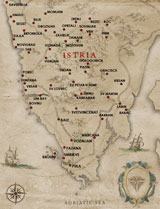
or choose the place
from the menu below
 Rome |
 Byzantium |
 Venice |
 Vienna |
 Brioni |
 Smrikve |
 |
 |
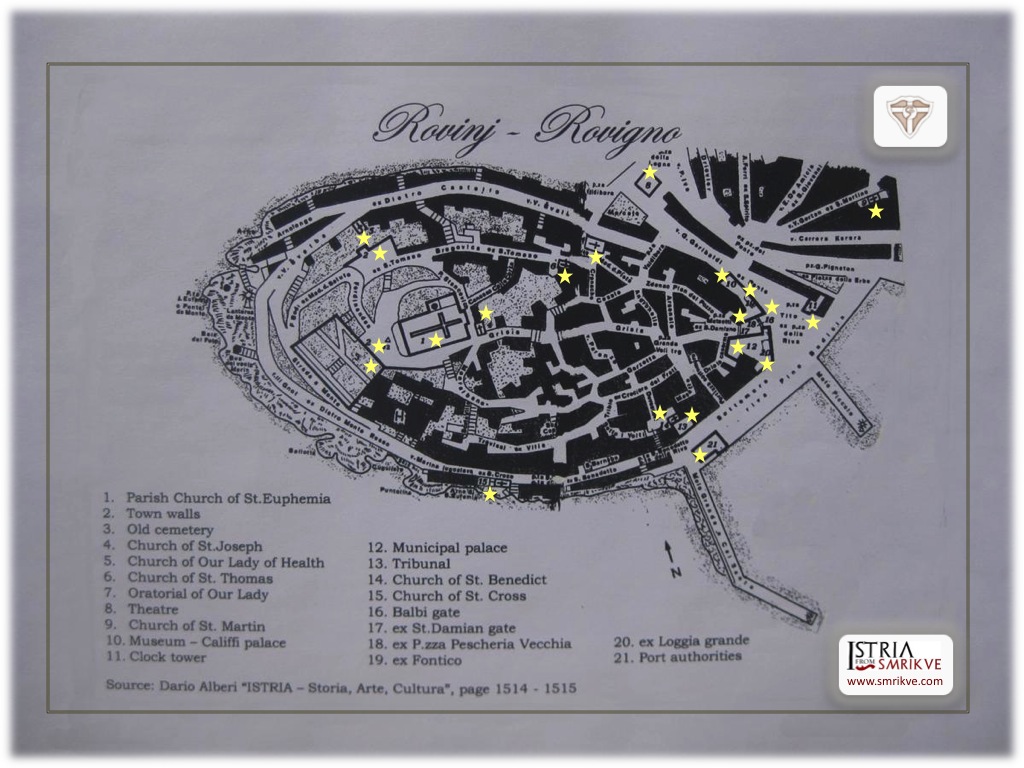
The last three buildings that are worth to be seen are located on the hilltop above this large street that goes from the Chapel of Holy Trinity and pass nearby the Church of St. Charles and end in a nice Baroque square.
 If you walk till the end of this
large street you will arrive near to a cross road and a small square with few picturesque Baroque houses. On the cross road
take the larger road that goes towards the hilltop. The road will be located on your right side if you arrive from the Chapel
of Holy Trinity direction.
If you walk till the end of this
large street you will arrive near to a cross road and a small square with few picturesque Baroque houses. On the cross road
take the larger road that goes towards the hilltop. The road will be located on your right side if you arrive from the Chapel
of Holy Trinity direction.
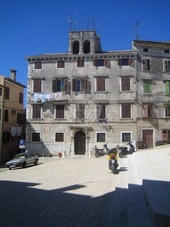
About fifty meters from there you will arrive in a larger square with two Baroque houses from the 18th century on it. The first one has a sort of tower in the middle of the façade with two vaults windows. The other one has a particular loggia on top of the building and this house belonged to Angelini family.
 If you continue to follow the
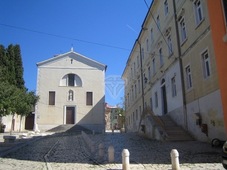
street towards the hilltop you will arrive in front of the Church of St. Francisco d'Assisi from 1750 with
the attached Monastery that was built in 1702. In origin the Monastery was built as charitable institution and in 1946 was
turned into Monastery. Nearby the church, on the opposite side of the street, the large building you see is the school.
If you continue to follow the
street towards the hilltop you will arrive in front of the Church of St. Francisco d'Assisi from 1750 with
the attached Monastery that was built in 1702. In origin the Monastery was built as charitable institution and in 1946 was
turned into Monastery. Nearby the church, on the opposite side of the street, the large building you see is the school.
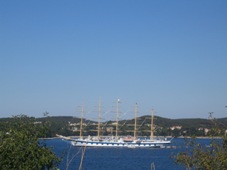 Rovinj is really nice and I have described some of its most important buildings but you will feel and enjoy
the atmosphere of the town in every your visit.
Rovinj is really nice and I have described some of its most important buildings but you will feel and enjoy
the atmosphere of the town in every your visit.
For nature enthusiasts it is recommended to visit Golden Cape forest park – Zlatni Rt, one of the most significant park forests of the coastal region and the first protected park forest in Istria. This park is located in the southern part of Rovinj. It is also recommended the visit of ornithological reserve at Palud that is a sort of the bird sanctuary with over 200 resident and migratory bird species in one place.
In the area of Rovinj the wine that you should taste is the wine produced by Zuzic family. Igor and Viliam Zuzic also own a wine bar named Grotta located at the entrance of the old town nearby the old Gandusio theatre. During your stay in Smrikve you can plan different visits to Rovinj and you will enjoy it every time in a different way.
In Rovinj’s photo gallery you will find several pictures of this beautiful and charming town located on the western Istrian coastline.
ROVINJ – HISTORICAL OVERVIEW
Like many other Istrian towns and villages also Rovinj is a very old settlement. It rose on an island which was separated from the land by a tiny canal. There are many different opinions about the origin of the name.
One story is that the old Rovinj existed on the Island of St. Andrew, also named Red Island, when between the 8th and the 9th century the land was over flew by the water like Atlantide and people moved on the Red Mount where St. Euphemia is today.
Mons Rubens or Mons Rubineus would mean Red Mount. This legend might have a part of the true because a nearby town named Cissa suffered two earthquakes in 754 and 801 and the sea over flew the town and people moved to Rovinj.
There is another story related with Cissa and also linked with Rovinj that is worth to be mentioned.
In the 13th century people wrote a legend related with St. Euphemia that say that around year 800 a sarcophagus with the body of St. Euphemia arrived from Constantinople.
In reality according to Kandler it is likely that in 524 the body was moved from Constantinople to Cissa and when Cissa suffered the second earthquake and the sea over flew the town people moved with them the body of the Saint to Rovinj.