to enlarge

or choose the place
from the menu below
 Rome |
 Byzantium |
 Venice |
 Vienna |
 Brioni |
 Smrikve |
 |
 |
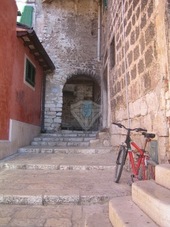
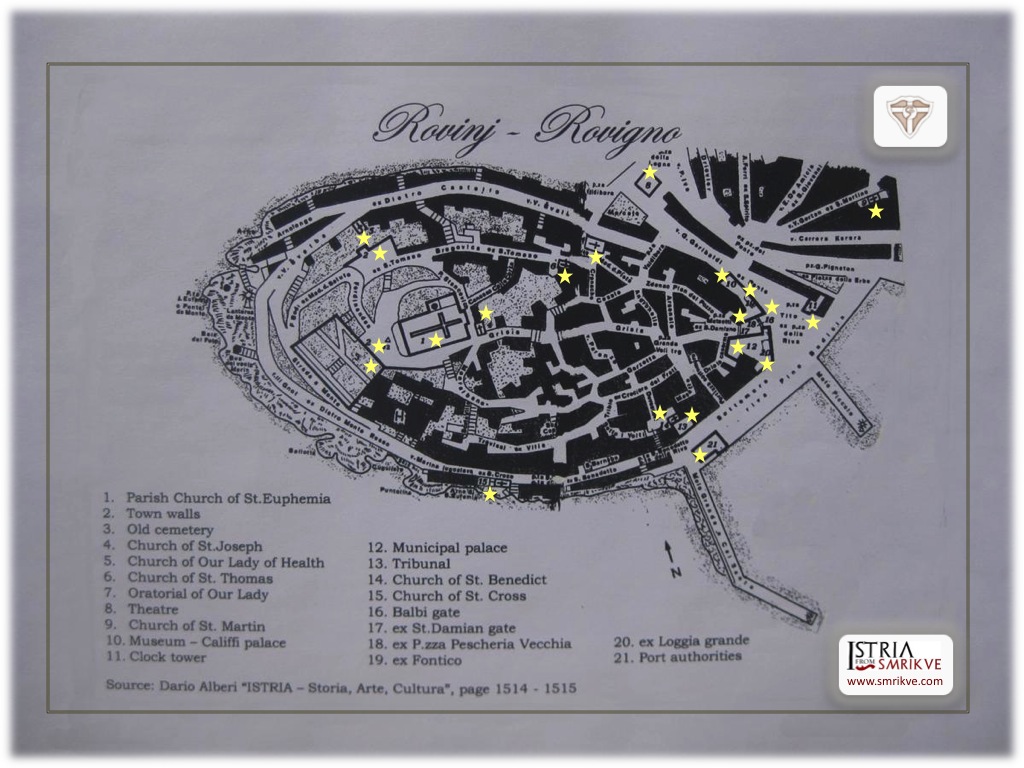
After Batana house museum there are two very old town gates that you should visit in this southern part of the old town.
The first gate was named St. Benedict gate and today are named seashore gate. This gate probably dates back into 1589.
If you pass the gate and take the look towards right you will note a very simple and small Church of St. Benedict from 1589. The gate for sure got its old name from the name of this church.
If you turn back to the main street and continue to walk further you will arrive nearby the second town gate on this southern part of the town and this gate was named the gate of the St. Cross and today are named the naval gate.
This gate also dates back ingo 1589 and they got this name in origin from the small church with the porch placed on the other side of the street, on the coastline.
_small.jpg) The Church of the St. Cross was built few years later, in 1592. Nearby
this small church you will note the stairs of the Valentino bar that is particular for the lights placed
in the sea and the natural coastline are the seats and the tables.
The Church of the St. Cross was built few years later, in 1592. Nearby
this small church you will note the stairs of the Valentino bar that is particular for the lights placed
in the sea and the natural coastline are the seats and the tables.
This is another charming place where you can enjoy a drink and listen together with the musice the sounds of the waves and the sea.
The buildings that have been described above are all placed on the former Island area of Rovinj but there few other interesting buildings that are located in the part of Rovinj that developed later on, on the main land.
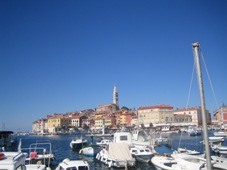 You can take a walk till the other side of the bay where the Church of St. Nicholas from 1364
is located. From this place you have another beautiful view towards the southern part of the old town and the Church of St.
Euphemia with its Venetian bell tower.
You can take a walk till the other side of the bay where the Church of St. Nicholas from 1364
is located. From this place you have another beautiful view towards the southern part of the old town and the Church of St.
Euphemia with its Venetian bell tower.
This view is similar in beauty to the view you have from the parking place towards the northern part of the old town.
Another building that is worth to be seen is a heptagon Romanesque building, the Chapel of the Holy Trinity with cupola from the 13th century. This is the oldest preserved sacral building in Rovinj.
Behind the Church of St. Nicholas you will note a narrow street that goes on the left.
Take this street until you arrive till the main larger street. Once you have arrived in this large street take a look on your right side and you will note this Romanesque building.
If you take the street that goes upwards on the left side of the Chapel of the Holy Trinity you will see in the park, on your left side, two large and relatively recently built buildings.
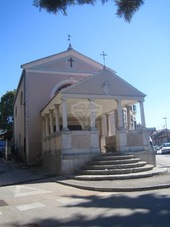 About hundred meters form the Chapel
in that direction there is also a Church of Our Lady of Kindeness with particular neoclassical porch. The
church was built in 1584 and restructured in the 18th century, while the neoclassical porch was added in 1750. The church
hosts inside the tomb of the Countess Califfi.
About hundred meters form the Chapel
in that direction there is also a Church of Our Lady of Kindeness with particular neoclassical porch. The
church was built in 1584 and restructured in the 18th century, while the neoclassical porch was added in 1750. The church
hosts inside the tomb of the Countess Califfi.
If you go back near the Chapel of the Holy Trinity and turn back in that large street, after fifty meters you will note on your right side a nice building of the Italian community. The building has two baroque balconies on the first and second floor.
Another fifty meters from there, always on your right side, you will note the red façade of the Church of St. Charles from 1650. There is another small Church in that area, in a small street above this large street, almost hidden between the houses. It is the Church of St. Martin built in 1589.