to enlarge

or choose the place
from the menu below
 Rome |
 Byzantium |
 Venice |
 Vienna |
 Brioni |
 Smrikve |
 |
 |
_small.jpg) Rigo family built also a countryside complex outside Novigrad in Karpinjan that was
one very attractive countryside properties in Istria built in the last several centuries.
Rigo family built also a countryside complex outside Novigrad in Karpinjan that was
one very attractive countryside properties in Istria built in the last several centuries.
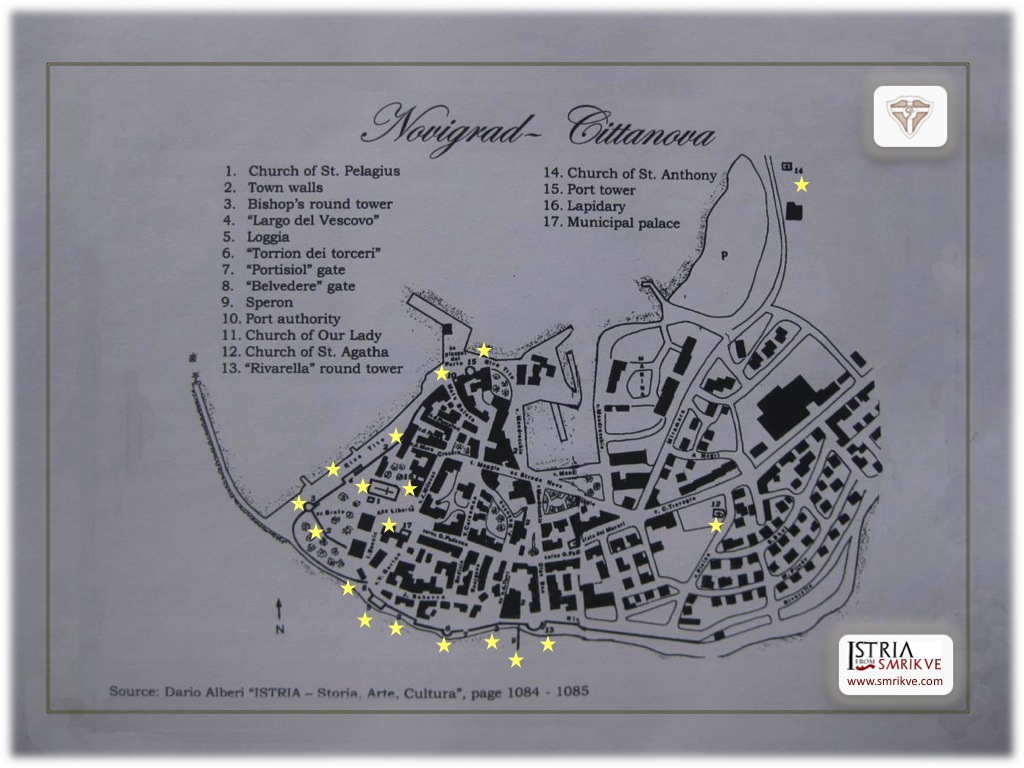
Not far away from this building always on the left side of the street you will see another building from the 18th century with a pretty Gothic Venetian windows. On the exit of the town you will see the Church of St. Anthony that was restructured in 1631 by the family Busini. In front of this church there was an old Roman pier about 8 meters large.
In Novigrad you will find three top Istria restaurants: Pepenero, Damir and Ornella, and Cok...
NOVIGRAD – HISTORICAL OVERVIEW
Novigrad is another old Istrian town although its name would mean in English the New City.
During the Roman period was named Aemonia although the oldest Novigrad name is assumed to be Emonia.
Emonia should be a Greek name that derives its origin from the name of the Mount Hemos, today known as Balkan.
Some assumptions are that in the origin the founders of Novigrad could have been Greeks.
The antique Emonia was probably located few kilometres away from todays Novigrad as proved by some later documents and findings.
In the 5th or the 6th century a new castle was built and was named Novezio or Noventium because the old Emonia was destroyed in a war. It is assumed that Novigrad was a Bishopric seat already in the 6th century. It lost this designation in 1828.
In the 7th century the geographer from Ravenna named Novigrad as Neapolis. Probably the geographer wanted to indicated that this was the new city established nearby the old Emonia.
In the 9th century the latin name of Novigrad was Civitas Nova and later on Novigrad was also named Civitanova, Castrum Novas and Zidanova. The confirmation that Novigrad has the old Emonia origins could be the fact that Novigrad Bishops named themselves Emoniensis after 1146.
It is interesting to remind that in 1029 Novigrad Bishops obtained also the feuds of Dajla and Umag.
In 1149 Novigrad swore for the first time its fidelity to Venice. In 1180 Novigrad was probably part of the Aquileia Patriarchs dominions in Istria.
Since the fall of the Roman Empire Novigrad, as most of the other Istrian towns and villages, changed several rulers.
The most important to recall are: Byzantium Empire period, Longobards, Carolingian kings and other Emperors ruled over Novigrad.
From 1270 until the fall of the Venice Republic Novigrad was ruled by Venice. In that period it was an important harbour for transportation of the wood to Venice.
Since 13th century Novigrad had its own town statute that later on in 1402 was written in Italian. This is probably the first town statute in Istria written in Italian.
Several times Novigrad suffered plague and was involved in the wars that affected most other Istrian towns and villages during the history.
Novigrad Bishops owned several feuds and over the centuries they were giving them to various Noble Istrian families such as: Counts Sabini, Verzi, Vergerio, Del Bello, Grisoni and Gravisi.
With the fall of Venice, Novigrad became a part of the Austrian Empire and for a short period of time was under Napoleon domination.
After the First World War and fall of the Austro-Hungarian Monarchy was part of Italy and after the Second World War became part of Yugoslavia (Croatia).
During the Italian Fascist period in Istria many Istrian families suffered from the regime or had to leave Istria. Fascism in Istria applied various repressive measures mostly towards Slav populations and this created the Antifascist Movement.
The Second World War was a very painful experience for the Istrian population and many innocent Istrians, both Slav and Latin, died during that war.