to enlarge

or choose the place
from the menu below
 Rome |
 Byzantium |
 Venice |
 Vienna |
 Brioni |
 Smrikve |
 |
 |
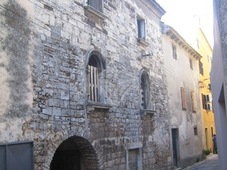 Most other Istrian building had the angles
of the houses made of big stone blocks and for the rest of the walls every kind of the stone was used.
Most other Istrian building had the angles
of the houses made of big stone blocks and for the rest of the walls every kind of the stone was used.
Historically, Istrian people had a good sense for what was beautiful and they used to plaster and colour the walls of their houses with nice natural colours.
I wanted to remind this fact because today many people think that the old Istrian houses had stone made façades, in reality, the example I took above tell you that only the richest families and the Bishops had the possibility to made perfectly stone made blocks and to build houses and some churches with that technique.
If you look the art work that was made by Branko Orbanic in Kanfanar, on a house his people turned into original beauty, you can see how this houses were nice coloured a long time ago.
It is an invitation to the people not to be afraid to put the colour on their facades if they restructure the old Istrian houses. It is another type of art work as you can see from what Baranko Orbanic did.
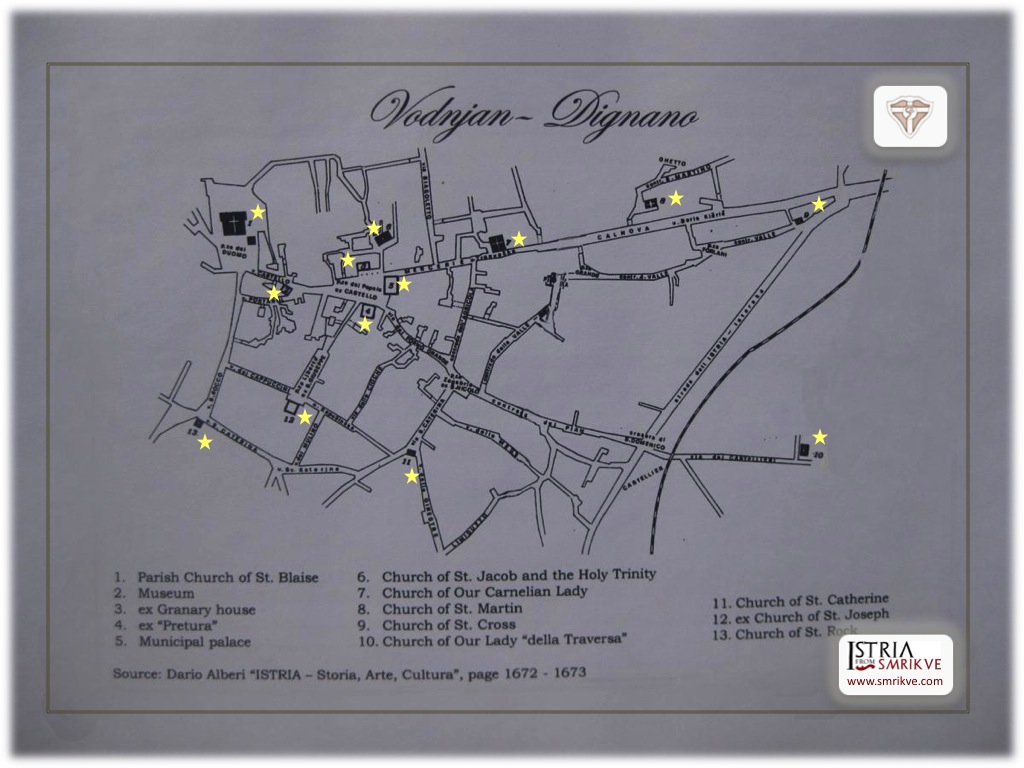
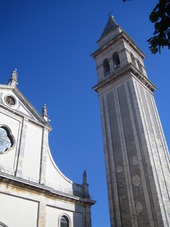 Not far away after Betica palace you will be in front of the Parish Church of St.
Blaise and its 63 meters high bell tower.
Not far away after Betica palace you will be in front of the Parish Church of St.
Blaise and its 63 meters high bell tower.
Vodnjan's bell tower is considered to be the tallest one in Istria.
The church was built from 1761 till 1808, and the bell tower was made in 1882. It is the largest church in Istria: 56 meters in length, 32 meters in wide and 25 meters high.
If you are interested in the sacral art you should visit St. Blaise’s Church that host a unique collection of mummified bodies of saints and a collection of sacral art.
There are several bodies of saints and the most known are: Saint Leon Bembo, Saint Giovanni Olini and Saint Nicolosa Bursa.
A collection contains a series of valuable artworks from the 14th to the 19th century like: the polyptych of the Blessed Leon Bembo from 1321, the work of the famous Venetian painter Paolo Veneziano, and the Renaissance triptych of the Blessed Leon Bembo from the 16th century made by Lazar Bastiani.
The collection contains also many different reliquaries. The largest part of the collection was brought from Venice to Vodnjan in 1818 by the painter Gaetano Gresler. He gathered together the collection during the Napoleon’s rule. Gaetano Gresler also painted some walls inside the church.
Until 1700 this Parish Church hosted also some artworks painted by Tintoretto, Palma and Veronese but there are no information where are these artworks today. There are several other valuable paintings hosted in the church.
The façade of the Church is very similar to the Parish Church in Bale.
It is known that the Parish Church of St. Blaise was made taking as example the Church of St. Peter in Castello in Venice that was projected by the World famous architect, Andrea Palladio, while the bell tower was built using as example the bell tower of St. Mark in Venice.
For years the construction was under the direction of architect Domenico Dongetti from Piran. The façade is from the late Baroque period but if you focus your view on the top and the middle of the facade you will note the neoclassic elements of the construction that reminds the Palladio style. The bell tower was projected by Antonio Porta from Trieste.
From the Parish Church if you take the street that goes towards south you will arrive to the last existing church in the town of Vodnjan, the Church of St. Rock from the 17th century.