to enlarge

or choose the place
from the menu below
 Rome |
 Byzantium |
 Venice |
 Vienna |
 Brioni |
 Smrikve |
 |
 |
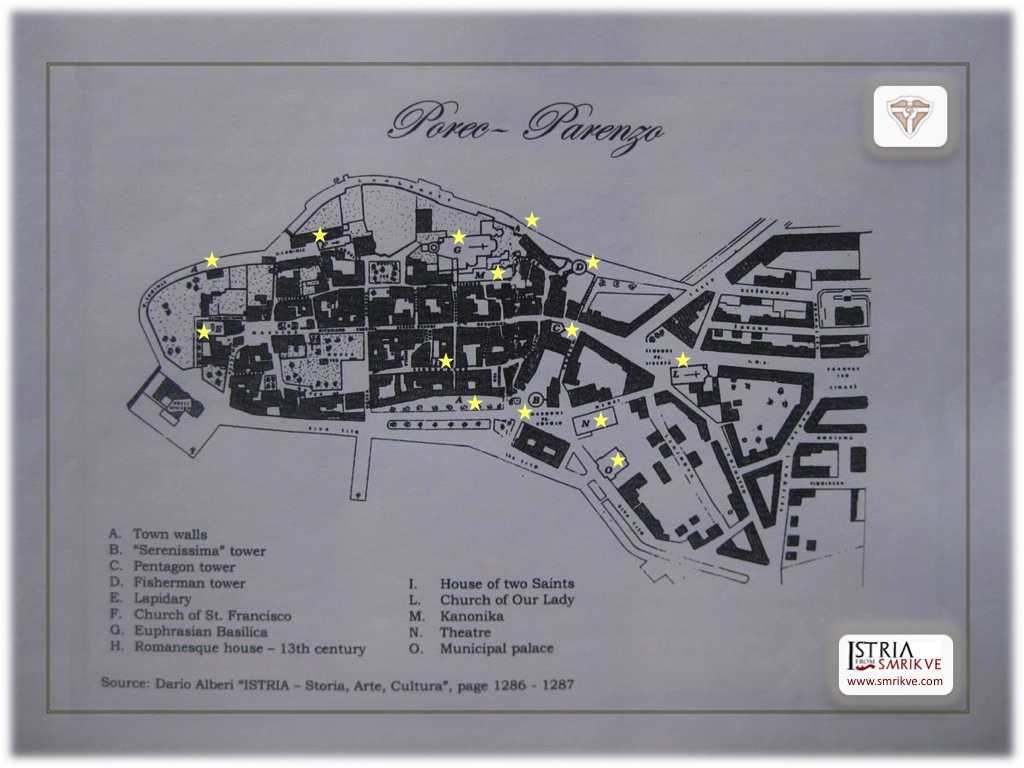
Near to the theatre, on the right side, there is another nice building which is the seat of the Municipality. You will recognize it for its three big vaults on the ground floor and five “Renaissance” windows with four stone columns on the first floor. This building was projected by Ruggero and Arduino Berlam from Trieste.
_small.jpg) There are few other building that are worth to be seen in the old town. You need to
turn back and enter the Cardo street and later on take the first street that goes towards right. Few meters from there and
you will be in a small square where a very particular house stands. Usually the beauty in architecture is measured with symmetry
but this house is particular for its asymmetric windows.
There are few other building that are worth to be seen in the old town. You need to
turn back and enter the Cardo street and later on take the first street that goes towards right. Few meters from there and
you will be in a small square where a very particular house stands. Usually the beauty in architecture is measured with symmetry
but this house is particular for its asymmetric windows.
In the same street continue to walk and look carefully on the left side of the street there is the House of Two Saints with Romanesque features that dates back into 13th century.
In the 13th century there was a Benedictine Monastery. Nearby the window on the first floor on each side you will note stone sculptures of the two saints: St. Cosmas and St. Damian. This is one of the most important Istrian art works from that period.
Not far away from the House of Two Saints there is Lapidarium bar that have a lovely court yard with coat of arms of Porec’s Noble families displaced all around the walls. Lapidarium is the bar that I prefer in Porec. It is very lovely and during the summer it is very nice to have a drink there in the evening. Many time jazz concerts are organized.
The last building complex that is really worth to be visited in Porec is the Euphrasian Basilica that is located in the northern part of Porec.
The complex was built in the 6th century, between 543 and 554 by Bishop Euphrasian, and is part of the UNESCO protected world cultural heritage.
It represents a unique example of Byzantine arts in Istria. It is the earliest example of a three naved church with three apses in the whole Western Europe.
_small.jpg) From Decumano street you will note Euphrasian Basilica gate that are
an imitation of Byzantine style doorway projected by architect Palgher and built in 1902.
From Decumano street you will note Euphrasian Basilica gate that are
an imitation of Byzantine style doorway projected by architect Palgher and built in 1902.
Before you enter Basilica take a look towards a beautiful stone made building on your right side. This Romanesque building dates back into 1251 and is the old residence of the canon. It is another example of the fine harmonious architecture and art work that comes from the old times.
Once you enter Basilica on your left side you will see the atrio which is surrounded by four porticos characterised by the harmony and refined simplicity. The baptistery building is an octagonal building with a baptismal fountain placed inside of it. If you take a look towards the sky in the atrium you will note the bell tower from 1522.
_small.jpg) Opposite to the baptistery there is the door of the Basilica. The most impressive part of the Basilica
are the mosaics in the apse. They are considered, according to their quality, to be one of the most significant
examples of wall painting from the 6th century in the World.
Opposite to the baptistery there is the door of the Basilica. The most impressive part of the Basilica
are the mosaics in the apse. They are considered, according to their quality, to be one of the most significant
examples of wall painting from the 6th century in the World.
The marble baldachin that stands on four columns was added in 1227. The columns are from the 6th century. Also the floor of Basilica is not the original one. At the entrance of the Basilica you will be able to see parts of the original floor mosaics and the original level of the floor.
The Basilica was built on the place where in 3rd – 4th century there was an older church dedicated to St. Maurus. Today only the foundations and floor mosaics of that older church have been preserved.